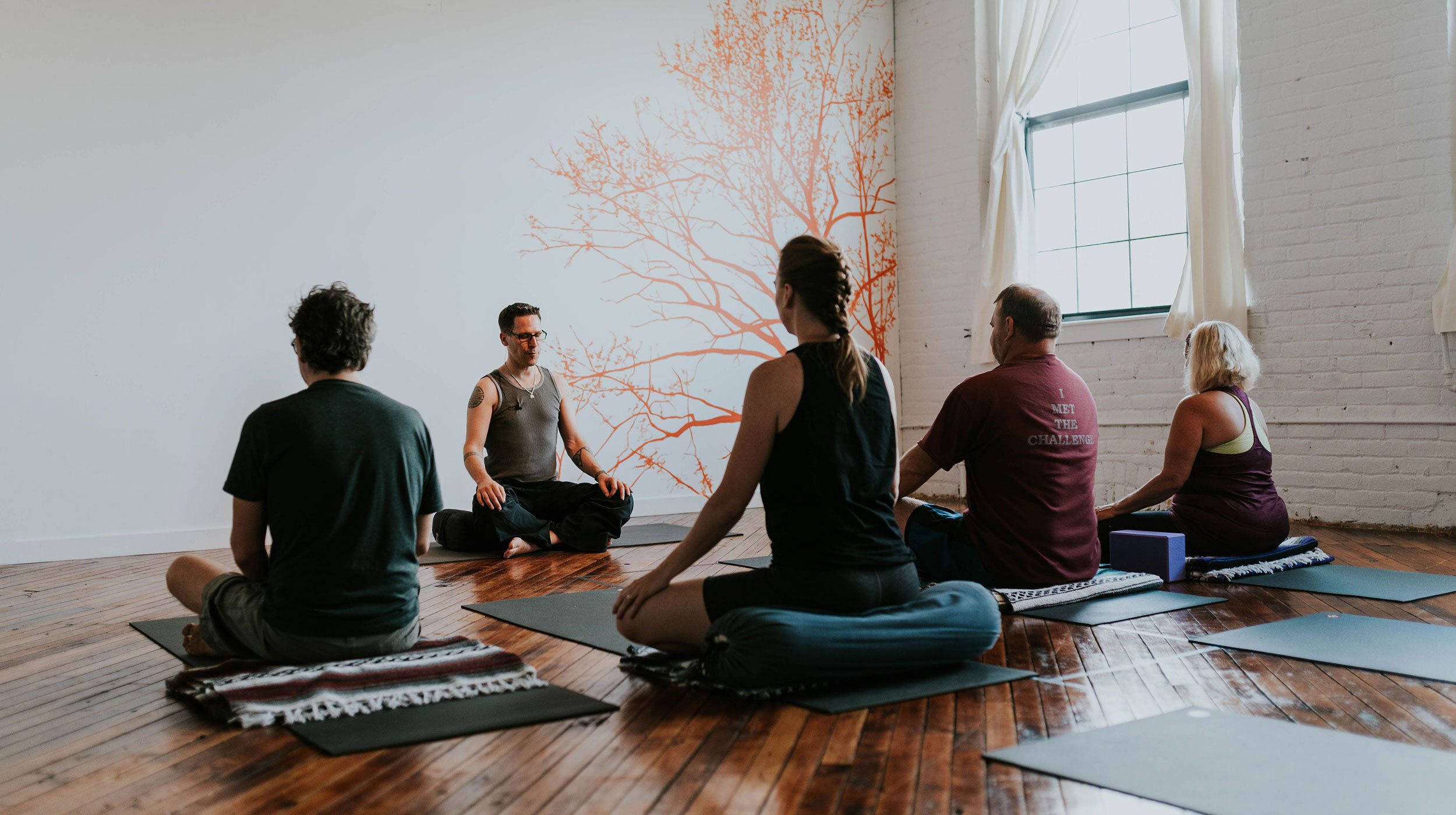


Hype surrounding meditation abounds. Wherever you look, someone is extolling the virtues of meditation while unwittingly sabotaging its occurrence. The intent is to help people better manage stress and enjoy more fulfilling lives. But what many refer to as meditation is often nothing of the sort and, with all the grandiose claims being bandied about, easily engenders more problems than it solves.
From a technical standpoint, there are rarely any distinctions being made between the yogic concept of meditation and what are readily being called “mindfulness exercises.” Even among yoga teachers and experienced practitioners, there is not much clarity regarding the last three limbs of Patanjali’s eight-fold path. The principles of dharana (concentration), dhyana (meditation) and samadhi (enstasy) are often being lumped together. Without getting mired in the semantics of ancient sanskrit words or in the subtle aspects of mind and experience, what is important to note is that there is little guidance being offered as to how any of the ideals being touted might be brought to fruition. Consequently, meditation becomes a magic pill that relies upon placebo effect and creates a dissociative hamster-wheel of seeking.
This happens with particular irony in the yoga world, where meditation is heralded as a badge of legitimacy. To say that “I meditate” is a way of signifying depth, that someone’s practice is not just a physical workout. Yet, more often than not, the practice is just a physical workout with a few minutes of sitting thrown in at the end. The actual practice amounts to a sweaty aerobic activity involving yoga poses where the heart rate is up, the mind goes out, and the “flow” takes over. Meditation is thought to happen when the focus goes inward and the mind is brought present and calmed. However, the few minutes of the runner’s high buzz that is enjoyed for some brief moments following the barrage of a standard vinyasa class are not likely to produce the many benefits that teachers espouse and we see listed throughout media outlets.
As J. Krishnamurti, one of the first pioneers of yoga philosophy in the West, put it: “Don’t fool yourself by all the books they write about meditation, all the people that come to tell you how to meditate, or the groups that are formed in order to meditate. We must be clear what it is that we are seeking, each one of us. When we say we are seeking truth or we are seeking God or we are seeking a perfect life and so on, we must already have in our mind a pattern or an image or an idea of what it is. So in seeking, is there not implied in that word, that we have lost something and we are going to find it? The first thing to realize is not to seek.”
The suggestion is that the context in which an endeavor for understanding meditation takes place determines the outcome of the endeavor. When we are told that meditation will alleviate everything from emotional imbalance to Irritable Bowel Syndrome, and will bring about everything from increased fertility to a knowledge of our true selves and maybe even enlightenment, its kind of hard to not be seeking for those things when we are sitting uncomfortably waiting for the allotted time to be done. And if we are seeking for something, whatever it may be, then we ensure its absence.
Listening to Deepak Chopra give a guided visualization about our inter-connectedness to nature and universal consciousness is a beautiful thing that likely has a positive affect for many. But this is not meditation. Nor is observing breath, chanting mantras, performing physical postures or sitting still. These sorts of techniques are intended to be a vehicle for concentrating the mind and easing the body, whereby some conditions are encouraged that tend towards an experience of meditation. But these techniques are not meditation in and of themselves.
The distinction between “mindfulness exercises” and the potential gifts that come from engaging in them is profoundly important. Yoga classes that are working the body in an aggresive manner or are placing too high an emphasis on accomplishing form are not setting a stage that allows for mediation. If the student is striving in practice, inadvertently or not, then this will most certainly find its way into any seated repose. And attempting to meditate as an activity, rather than understanding it to be the natural result of mindful practice, imposes a sense of lacking when there is none.
Meditation is a description of what happens as a consequence of healthy choices, not a prescription for bringing them about. When we have an intimate relationship with our actual lives, it simply occurs. Stop meditating. Learn to take pleasure in a regular practice that soothes the system and the rest is coming.

Since its inception in 1999, the Yoga Alliance has developed a deservedly bad reputation for collecting millions of dollars from the yoga community without providing any real service in return. However, a new president and CEO has taken over and the time may have come for yoga teachers and schools to rethink previous positions and explore the usefulness of a trade organization that is more responsive to their interests.
Let it be noted that I have been a long-standing and outspoken critic of the Yoga Alliance. In fact, after only a few months on the job, Richard Karpel, the new aforementioned CEO, read a somewhat infamous and damning blog post I wrote about the YA that prompted him to call me directly so he could introduce himself and tell me about his plan to turn things around. He was quite candid about what he found when he got there and the steps he is taking. I felt he was open to my perspective and genuine in his intention to improve the organization.
Setting aside for a moment the glaring and unresolved issues surrounding the credentialing of yoga teachers, Mr. Karpel succeeded in doing something quite interesting. He planted in my head a seed of possibility that the Yoga Alliance could potentially be of tangible value to the yoga community. The prospect all hinges on the confluence of our expectations and what the YA is actually capable of providing.
Significant changes have already been implemented. After some necessary legal restructuring, for the first time, the YA is now beginning to offer member services. Discounts on car rentals and cell phones may not sound like much now, but it appears that the YA will also be offering group-rate health insurance options. As a small yoga business owner who has been completely priced out of the independent market, and currently relies on state assistance programs to provide coverage for myself and my family, I can appreciate having another option for cheaper health insurance. This would be the first good reason I have ever heard for being registered with the Yoga Alliance.
Of course, most of the animosity towards the YA does not stem from the lack of member services. The main gripe and 800-pound Ganesh in the room is the issue of credentialing yoga teachers and schools. Here is where the expectations and realities are most at odds. Having engaged in dialogue and debate with yoga teachers of all stripes and statures on creating educational standards for the training of yoga teachers, I have determined that there really is no consensus ever to be had. I can honestly say that, in all these discussions, a good faith effort was made to find common ground. Nonetheless, the variant nature of yoga and how a yoga teacher comes to be simply do not allow for the imposition of arbitrary or pseudo-objective metrics. What’s more, all to often, earnest beginnings seem to readily devolve into a grasp for third-party reimbursement or a pedestal to stand on.
For those who bemoan the scourge of poorly trained yoga teachers and related injuries, demanding that a measly 200 hours is not enough time and that yoga teachers require more extensive study in order to ensure safety, I offer one simple and undeniable truth:
If a yoga teacher training program is providing instruction in practice that is injurious in nature, adding more hours to the program, regardless of what areas of study the hours are dedicated to, will accomplish nothing towards making the practice they teach any safer.
Now, I may not know a lot about politics or not-for-profit organizations but if there is one thing I have observed to be true it is that proposing something that has no chance of actually happening, just because it either makes you feel good or makes a point, is a sure-fire formula for nothing good happening. I know in my heart that the arbitrary setting of hours as a measure of yoga training has created artificial hoops that actually impede the learning process of teaching yoga, but I cannot escape the fact that the convention of 200-hour/500-hour certification is not going anywhere.
I have been out on a limb for years calling for a coup against the silly game that everyone is playing with the hours and public perception of the “credentialing” process. I have personally conducted yoga teacher training in both intensive and extended mentor formats. And anyone who has ever been intimately involved in the organization and implementation of a yoga teacher training program knows full well the subtleties of scheduled time, contact-hours, and actual learning that goes on. It bears repeating here: there is no oversight or consideration as to what actually takes place during said hours. So, as it stands, training programs are already only being held to the standards they set for themselves. Unfortunately, those standards are too often being tainted by the enabling emphasis on hours and the lucrativeness of yoga teacher training.
A sensible way forward might be to have a trade organization that promotes best practices by providing resources, education and incentives for registrants to conduct themselves with greater honesty and integrity. Sounds awful rosy, I know, but it’s not that crazy. Maybe we can stop kidding ourselves about hours and identify other ways to encourage more personal accountability. For instance, Registered Yoga Schools (RYS’s) could be required to submit not just a curriculum outline but also documentation, like copies of a lease or tax returns, to establish a requisite number of years of credible business operation. Registrants could be given an opportunity to write reviews and RYS’s would have an opportunity to respond to negative comments. RYS’s could connect to YA with certification numbers. And as a partial aside, a sensible grandfather clause is warranted. If people can provide pay stubs or tax returns to substantiate themselves as a functioning professional yoga teacher, for say seven or more years, then there is no logical reason why they should not have a path towards registration and participation.
The most important point is that the standards need to be presented as merely a suggested curriculum and include more content headings. This way, emphasis can be placed on competencies instead of hours and the actual relationship that exists between YA and registrants can be fully embraced. Otherwise, it will continue to be nothing more than a sham. The expectation that a 200-hour or 500-hour training certification can ever produce a fully fledged yoga teacher without mistakes must be dispensed with somehow. When it comes to yoga, there is no way to learn but on the job. Chances are that the terrible yoga teacher you took class with who was clueless and hurting people, didn’t end up making it as a yoga teacher in the long run, learned from their mistakes, or are caught up in a way of practicing that is ill-informed, in which case no amount of tinkering with curriculum guidelines will be of any use.
If the goal is to improve the quality of yoga training and hold yoga businesses and teachers to a higher code of conduct then attempting to create some sort of yoga police is absolutely counterproductive. It is simply not in the purview of an entity like the YA, or any other for that matter, to effectively regulate and enforce a standardized curriculum across the many diverse approaches, traditions and schools of yoga. The YA is a bureaucracy, like any other, with inherent flaws but potentially still providing some useful function or resource. I’m willing to give Mr Karpel the benefit of a whole lot of doubt because, ultimately, there really is nothing to lose. And sincere people always find incentive to do right.

Among those interested in yoga philosophy, many consider the notion of a “householder” interpretation to be a watering down of essential teachings. This stems from a classical view of yoga as an inherently ascetic endeavor, requiring a withdrawal from ordinary life in order to attain a state of unindividuated mind that is free from pain and suffering. However, a strong case can be made that not only is the mundane path equally steeped in the history and philosophies of yoga but that it is profoundly more relevant and helpful to modern practitioners then predominate dogmas.
Most of what people assert about yoga philosophy is conjecture. This is entirely appropriate given how far yoga reaches into the dim past; the thousands of years it existed as a purely oral tradition; the difficulty in translating texts that did arise, and the fact that the only true means of understanding yoga philosophy is through an examination of one’s own experience. Sure, there will always be those who cite some special authority. But it stands to reason that whoever these people were who may have composed the verses and provided the insights that have come down to us, however ancient, they were nonetheless human beings existing in time and space, no different from you or me. Whatever access to a knowledge of yoga they may have had is no less available to any other human being existing in time and space.
Unless of course, you believe otherwise. Which many people do. All sorts of hierarchies and power structures have been created in the name of yoga. These doctrines are far more established and propagated than the humble teachings that have always been passed from parent to child and friend to friend without any need for recognition or documentation. In the Upanishads, where the classical view was first being codified, reference is made to “the great householder” who asks the local spiritual authority: “Sir, what is that through which, if it is known, everything else becomes known?” He is informed that there are two types of knowledge: 1. Higher knowledge- which only he, the ordained lineage holder of god, can bestow, and 2. Lower knowledge- which would be coming from anywhere else other than him. Basically, the only way you can come to know the nature of existence is to renounce all worldly desire and become a disciple of an enlightened master.
Even if there were enough enlightened masters to go around, how can we ever really learn about the nature of life, and the role we play in it, if the goal is to somehow transcend or remove ourselves from that experience?
A few weeks ago, I learned about impermanence and the blessing of existence in a way that only an ordinary life can provide. I had driven my wife to a first sonogram appointment. She had been having some unusual pain that was causing concern but we were still genuinely optimistic that the second child we’ve been hoping for was indeed a reality. Quite a somber shock it was when she called to tell me that the pregnancy was ectopic and I needed to get her to another hospital straight way. By the time I got my daughter home, made arrangements for someone to look after her, and got back to the hospital, she had already just been taken into the operating room and I missed my chance to see her beforehand. I had been told that the procedure would not take long. After I had been sitting in the waiting room for a period of time that was twice as long as intimated, it started to dawn on me that there was a very real chance that someone might come through the door and tell me something went wrong, that I would never speak to my wife again and be faced with what the impact would be on me and our daughter were she to die at this stage in our life together.
For a good thirty minutes, I experienced the depths of all my attachments and fears. And it was both horrible and enlightening at the same time. The anguish of the possible loss was so overwhelming, so all-encompassing. Yet, when the nurse finally did come and I learned there was no problem, the majesty and glory of my tenuous mundane life was equally breath-taking.
My wife is fine now. We may still have another child. But regardless, there is no doubt that were it not for all the years of devoted effort towards cultivating our intimate partnership and family together, without the risk of being in the world and navigating all its pitfalls, I could never know what it means to exist and to love in the way I did when I got to hold my wife again.
Whatever grand spiritual principles or attributes that have been mentioned in ancient texts or uttered by charismatic teachers, regarding the nature and purpose of existence, can be gleaned in no better way than through a full participation in ordinary life. Let us not be fooled by the seemingly imperceptible way this understanding is communicated. Within our daily hum-drum routines, all the knowledge and experience we will ever need is contained.

Fifty years since the cultural revolution of the hippie generation, the inner child has all but disappeared from the self-help lexicon. In much the same way that the sixties message of peace and love has aged into something more like containment and indifference, few today hold much stock in the notion that there is an innocent child, full of wonder, at the center of their being. Regardless of one’s stance on the inherent benignity of people, a practical consideration of the inner child is worth much more than simply the punchline to a bad joke.
Contrary to what new-age rhetoric or common perception may suggest, the inner child is not a sweet little baby or an idealized source of freedom from inhibition and pain. Instead of attributing a false sense of purity or perfection to the inner child, I suggest that the inner child is no different from the average three-year old. And anyone who has ever lived with a three-year old knows that the innocence and wonder of a child can often manifest itself in horrible and frightening ways, ways that can take a person to the edge of sanity and cause them to act in a manner that defies better judgement.
It just so happens that I am the father of a three-year old girl. I once heard someone say: “terrible two’s, f***in three’s”, and I have to kind of agree. I am utterly amazed at how my daughter can so effectively rattle me, even at such a young age. I have spent many years developing equanimity in myself and a resilience to outside influences that might disrupt my awareness and behavior; that she has such an uncanny ability to bypass my well constructed firewall is striking. Recently, on a particularly challenging day, I actually wanted to hit her. I didn’t do it, but I genuinely wanted to and had to excerpt considerable effort to suppress the impulse. As mentioned previously, I have never wanted to hit another person in my life, much less my beloved daughter. I must admit, it freaked me out a bit. Especially because, when she saw that she had successfully pushed me completely outside of myself, she smiled in delight, as though she had succeeded in her mission.
If we think of the inner child as an archetypical three year old, in every aspect, then the concept takes on very real implications. Your inner child identifies things that you need or want and than purposefully stands in your way of getting them just to see if it can. If you protest, your inner child only laughs and is further fueled by your dismay. When you are at your most depleted and in desperate need of a rest, your inner child’s first instinct is to unrelentingly press your patience more in a concerted reach for your breaking point. Attempting to discipline your inner child is often confusing. What proves effective on one day does not always prove the same on another. And despite their yet-to-be fully developed cognitive faculties, the inner child is adroit at being just smart enough to never fall for halfhearted ploys.
Your inner child also has night terrors, unexpectedly waking from sleep in fits of hysteria that no amount of love or attention can console, and only subside after considerable horror and with the gradual introduction of established coping mechanisms. And even when these fits don’t come out of the dead of sleep, similar episodes can be triggered with no apparent cause, as your inner child is prone to drastic mood swings that invariably surface in the most inconvenient of moments.
Of course, all this is in sharp contrast to the other eighty percent of the time when your inner child is showering you with unconditional love. What a tragic irony it is that we are often too busy needlessly checking our iphones to notice. The extreme stress that your inner child can create from time to time easily ends up eclipsing all the other pleasant experiences we have and taints the mind towards suffering.
The other day I was feeling down on myself as a dad. Sometimes I get consumed with my work and am not present with my daughter. She is well aware when this happens and is not shy about communicating her disapproval. After I had ignored her for some time, she really got upset. When I finally looked down and saw the disappointment in her face, my heart dropped. I started weeping uncontrollably and said: “I’m sorry, sweetie. I’m not being a very good dad today, am I?” She threw her arms around me and said: “It’s OK. You’re a good dad and I love you. Just turn off the computer and come play with me.”
It’s difficult to grasp how my daughter can be, all at once, both a demon sent to derail me and an angel who saves me from myself. Or how, as adults, this same paradox plays itself out inside each of us. As we enter the time of year where resolutions generally go to die, may we have the fortitude to draw lines where they need to be drawn, the courage to admit when we have drawn lines mistakenly, and trust that a true intention and best effort will prove enough to carry us through without regret.

Major tectonic shifts in the modern yoga world have created an entirely new landscape for both the industry and consumers. The founding generation of yoga trend-setters, whose innovation and entrepreneurial spirit fostered what is now established convention, have largely achieved the goal of ushering yoga into the mainstream of society, and no longer speak from the same obscure or vaulted mantles they once did. And some of the most renowned among these figures have fallen from proverbial pedestals, revealing the fallibility of yoga celebrity and a vacuum of substance.
The second official study of the yoga industry, since the first in 2008, was released last month and the perpetuation of yoga and related commerce has not slowed in the least. In the last five years alone, we’ve gone from 15.8 million to 20.4 million Americans practicing yoga, that is a 29% increase and represents 8.7% of American adults. Spending on yoga classes, equipment, clothing, vacations and media is estimated at 10.3 billion a year, almost double the 5.7 billion estimate from 2008. Among the 91.3% of Americans who do not practice yoga, 44.4% say they are interested in yoga but have yet to give it a try.
I started teaching yoga when I was 23 years old. At that time, there was no google, youtube, facebook, twitter or Lululemon. There was no 200-hour yoga teacher certification. There were no commercials for banks with people doing yoga poses in them. And there was no multi-billion dollar yoga industry to fuel. Now, I’m forty years old. I am married with a kid and I own a yoga center and train yoga teachers in my neighborhood of Brooklyn, NY. I rode the crest of the yoga wave that started in the early nineties and have grown into my adulthood along with the emergence of yoga in our culture.
I remember watching the rise of John Friend and Anusara Yoga and thinking to myself: “Wow. This is the future. This is what is possible for a yoga teacher to achieve.” Now that the brand is all but defunct and the man is considered by many to be a pariah in the field, there is a tragic irony to the youtube videos of once prominent and self-identified Anusara Yoga teachers who sincerely hope to help others better brand themselves into abundance.
Things have certainly changed when a teacher who, over more than a decade, earned reputation and standing for an overly aggressive teaching style, is now considered an expert on the injurious nature of yoga. And a senior science writer from the NY Times who was once an expert on the proliferation of nuclear weapons is now writing about the proliferation of yoga. Unfortunately, his reductionist assertions about the safety and origins of yoga and the sensationalizing of scientific data has served to obfuscate the issues more then further any understanding or educate the public.
Among serious-minded practitioners, there is palpable discontent with the course the yoga industry seems to be on. Teachers, who in the past were voices defining what yoga is in the 21st century, are now understandably more concerned with enjoying their latter years then attempting to push back against entrenched forces that care little for the soul of yoga. The newer generation has often been thrown out into the wilderness without the tools or knowledge to fulfill their impulse to carry the torch. In the absence of teachers framing the conversation and defining yoga in authentic ways, the market will always fill the gap with whatever sells.
The good news is that we may be reaching a turning point. That will happen when enough people who have practiced yoga for long enough come to their own informed determinations about what yoga is and why they practice it. I can’t think of the last time I met someone who had never heard or read of yoga before. There is a new savvy among the uninitiated and greater discernment among veteran attendees. And while most of what they hear and read about yoga is horribly inaccurate, still more and more, people understand that yoga is being utilized with different purposes and there are choices to be made.
Folks are not buying just anything as yoga anymore. And they are telling their friends. The rampant commercialization and co-opting of yoga has become so overblown that even the unfamiliar are skeptical. Times remain too tough to effectively continue hocking candy-coated platitudes. From out of the daunting malaise of pressures and seeming demise, conditions are becoming more ripe to slough off obsolete thinking. No more will we be led around by false gurus or complacent with hypocrisies. No longer will success be defined by status or achieved at the expense of others. We can and will do better. Let us have the courage to imagine it so.

Regardless of ones station, there is little chance of making it through a lifetime without some amount of difficulty and pain. Acknowledging this fact is useful in potentially encouraging more plausible expectations and acceptance of the way things are. However, too often, this inextricable truth is misperceived and becomes an enabler for imposing needless suffering upon ourselves and others.

Referring to a yoga center with the caveat: “it’s not-for-profit” often carries with it an assumption of merit. Given the humanitarian and universal nature of yoga, taking the profit motive out of the business model seems ideal. However, a further examination of the trade-offs involved in opening both for-profit and not-for-profit yoga centers challenges this assumption.

Adepts have told us that yoga can be found in anything. But does that mean that anything can be yoga? With all the mixing and combining of yoga with other activities going on these days, the line between what constitutes a yoga practice and what does not has certainly become blurred and invites us to wonder why so many people find yoga insufficient on its own.
A quick google search reveals an array of hybrids and pairings: yoga and pilates, yoga and fitness, yoga and martial arts, yoga and capoeira, yoga and wine, yoga and chocolate, yoga and weight-loss, yoga and writing, yoga and whatever someone can think of to try and create a niche for themselves. The trend is understandable. Niche marketing in today’s economy is often essential to survival.
However, there comes a point where being all-inclusive and marketing anything under the sun as enhancing a “yoga lifestyle” ends up sacrificing the real benefit of yoga practice. Of course, there is the supposed silver lining that even if yoga is being exploited, these ploys are still exposing people to yoga; but this is really nothing more than a red herring.

Exposure to and understanding of yoga are often being shaped by business interests and market forces. When someone who holds yoga dear sees yoga being portrayed with dubious purpose or in a less than sacred light, it’s easy to feel disheartened.
I have often derided the “yoga industry” or “commercial yoga” as though it were a boogie man that is out to get us. The emergence of new anti-establishment voices in the yoga blogosphere has spurned even harsher scrutiny of “yoga culture.” Expansion of the internet and social media has led to more of a real dialogue about yoga then at any other time since it became my life pursuit. However, some of these new voices have caused me to question my own.
When we criticize the “yoga industry” or “commercial yoga”, who exactly are we referring to? Yoga Journal? Yoga Alliance? Lululemon? Big name yoga teachers who have managed to make a buck? Or perhaps, it’s really just the commodification of yoga that presents us with an unresolvable dilemma and no place in particular to point the frustration. Fact is, regardless of the commodity, industry only exists where there is a consumer to be had. So, it stands to reason that a predominance of educated and informed consumers can reflexively shape an industry.

According to the American Medical Association, 80 to 85 percent of all human illness and disease can be attributed in part to stress. Over two-thirds of all office visits to physicians are for stress-related illness. Stress is a major contributing factor either directly or indirectly to the six leading causes of death in the United States. In a recent study, 75 percent of yoga students reported attending yoga classes for stress management.
Yet despite yoga’s reputation for stress reduction, yoga classes regularly exhibit a lack of understanding about the nature of stress or how to effectively address it. Often, people talk about stress as though it were a lactic acid in their muscles that just needs to be stretched out. Surely, one of the great boons of an appropriate yoga practice is its capacity for alleviating some amount of musculoskeletal tension. And there is some interesting science being done on the release of gamma aminobutyric acid (GABA). However, this is merely scratching the surface when it comes to dealing with stress in the sort of epidemic proportions that we currently face.

Fierce debate springs eternal among yoga enthusiasts regarding the merits of purely fitness-based sensibilities in yoga practice. Usually, it starts with someone from the more-than-fitness side feeling compelled to say out loud that Yoga is not just working out. To which, the inevitable response is that many people are utilizing yoga practice for physical fitness alone and it’s a beautiful thing so who are you to define yoga or pass judgement on anyone else?
In defense of the not-just-working-out view, common retorts involve references to ancient texts, concepts of energy or, more generally, declarations of divinity. At which point, those who care nothing for such things easily write off the argument as a bunch of hokum and the conversation either deteriorates into silliness or ends.
In a previous post, Mind-Body Connection Optional?, I attempted to make a distinction between physical fitness and yoga, drawing upon science and reasoned thought, but was still accused of casting aspersions and playing god. Last month, in No More Dancers Doing Yoga on Youtube, I asserted that “advanced yoga” can not be measured in poses and that an emphasis on developing mere physical prowess does a disservice to yoga.
Much to my surprise, there was virtually no backlash from the fitness side. In fact, the majority of comments were from those who agreed with the sentiment and felt inspired to expound upon what makes yoga “advanced” or not. From the responses, it is clear why deference might be given to the notion that yoga is about physical fitness. Because there is wide disagreement and a lack of common language, among those who embrace yoga as more than physical fitness, as to what the non-physical aspects of Yoga are.

Whenever I watch the latest viral video of a scantily clad babe doing acrobatic yoga in her living room, something in me laments. I realize that these videos serve as inspiration to others and I appreciate the beauty, skill and sense of personal empowerment they represent. But I can’t escape the feeling that these displays are better left to the performing arts than to a yoga mat.
To be clear, some of these clips are undeniably cool. I’m a sucker for good indie rock and, from a creative standpoint, the execution is certainly impressive. My problem is that, regardless of intent, these performances are playing right into prevalent and misconceived notions about yoga. In the same way that the use of abstracted and idealized body imagery in advertising has a diminishing effect on people’s self-esteem, so do these flashy presentations obfuscate the purpose of yoga practice and intimidate the uninitiated.